Daria Barkova: Art Profiling Turns the Inner World Into a Visual Map
Daria Barkova - creator of Art Profiling and The Path of the Lemon, on visual identity, personality analysis, entrepreneurship, AI, and why true individuality begins with the right to be yourself.
1. What is Art Profiling, and how is it different from a classical portrait or psychological testing?
Art Profiling is a method of visual personality profiling, where I create an individual artwork as a precise visual instrument that reflects a person’s inner structure at a specific moment in their life: their agency, priorities, limitations, inner conflicts, and potential for transformation.
Unlike a classical portrait, which captures appearance and sometimes character through symbolism or mood, Art Profiling does not depict a person literally. It is not a “similar-looking portrait,” but a metaphorical map of the inner world. The artwork becomes a mirror in which a person recognizes themselves more deeply than through words.
Unlike standard psychological testing — questionnaires, MBTI, Big Five, and so on — Art Profiling does not work through verbal answers, which are often influenced by social desirability. It works through image and metaphor. An image bypasses rational control and speaks directly to the unconscious. It captures not only what a person already understands about themselves, but also what is only beginning to emerge.
It is a living instrument: the artwork can be interactive, like The Tree of Life with magnets, and it continues to work with the person after it has been created — provoking recognition, inner dialogue, and internal shifts.
2. How did you come to the idea of using art as a tool for personality analysis?
This idea was born from many years of observing the same phenomenon in my work with entrepreneurs and top managers.
For many years, I worked in HR, personality profiling, and with founders and executives at moments when they clearly understood that change was necessary, but could not yet see or feel that change. They had readiness, but they did not have an image. They lacked form.
Words, tests, charts, and reports helped on the intellectual level, but rarely reached the point of a deep internal shift. A person could understand everything rationally, while the body and the unconscious continued to live according to old patterns.
At some point, I realized that an image works faster and deeper than an explanation. An image bypasses the resistance of the rational mind and immediately speaks to the part of us responsible for self-recognition.
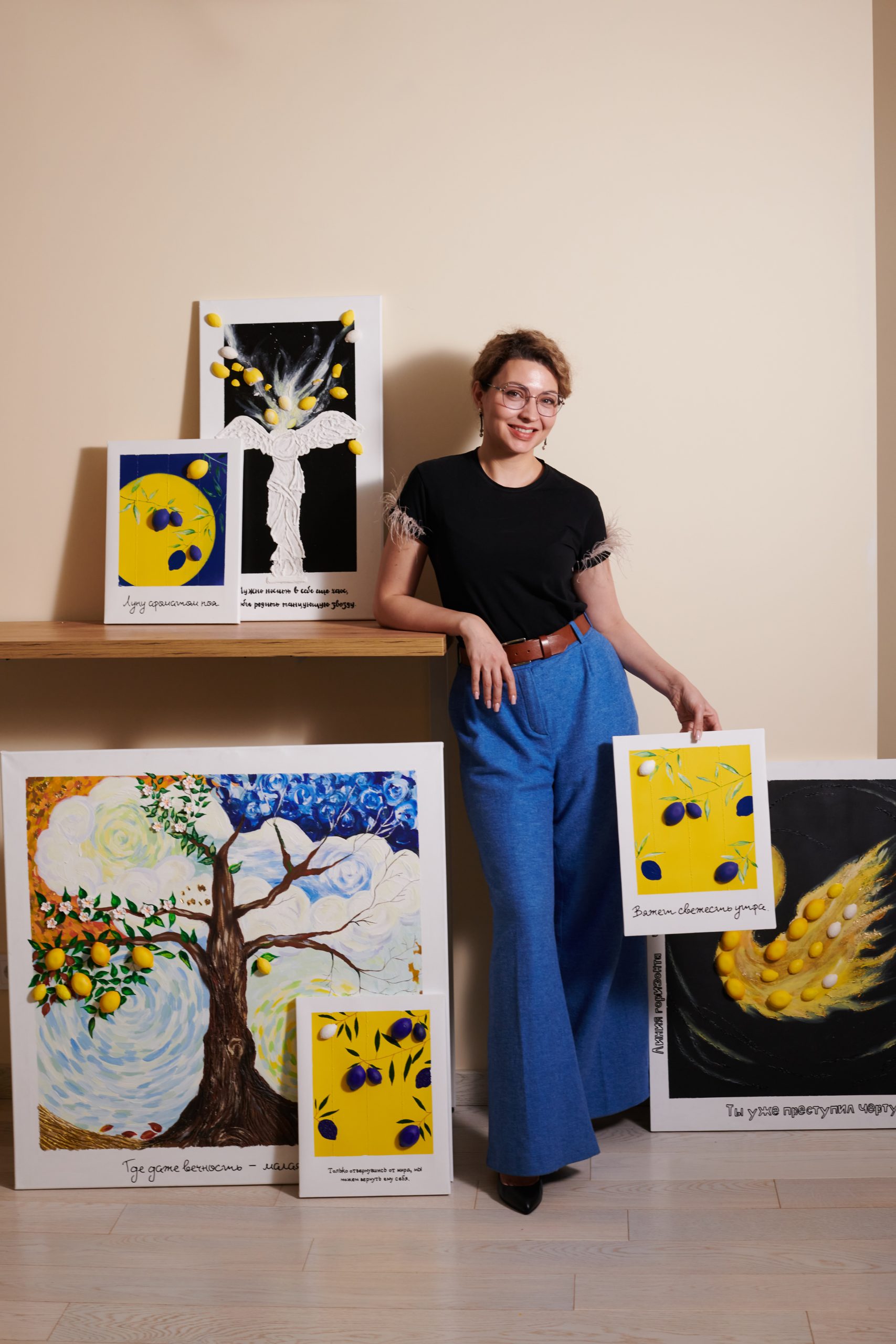
That is how Art Profiling was born. I began translating the results of profiling into a visual metaphor — precise, personal, and created specifically for this person at this particular moment in their journey. Not an abstract artwork “about a lemon,” but a specific visual instrument that makes visible their inner structure, agency, limitations, and growth points.
Art here is not the artist’s self-expression and not decoration. It is a working instrument of transformation, as precise as a map or a navigation system.
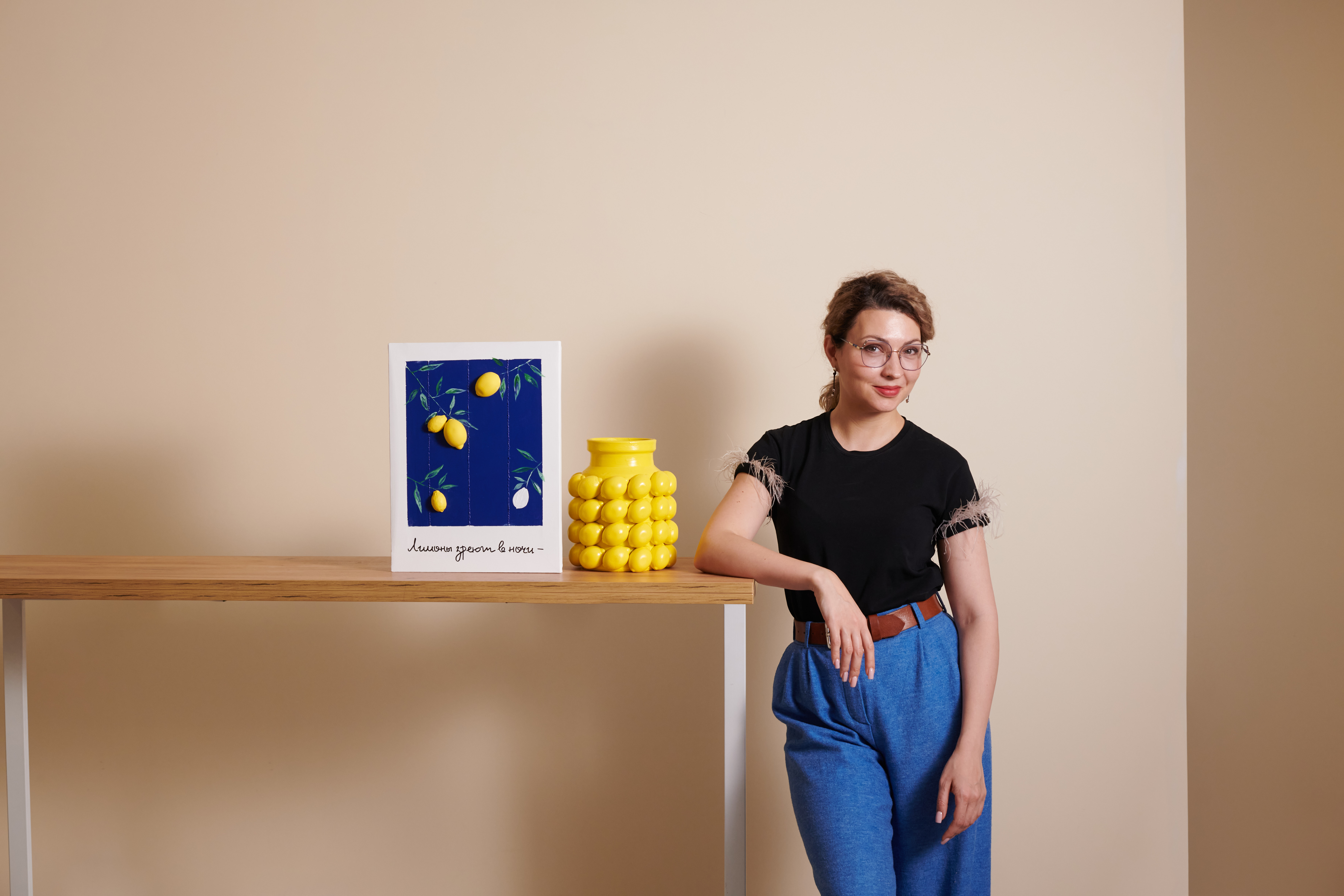
At first, these were experiments with clients. Later, they became a full methodology, reflected, for example, in my series The Path of the Lemon.
3. Can you really see a person’s character through visual images?
Yes, you can. And sometimes even more deeply than through many traditional methods.
Character is not a set of static traits, but a living system: priorities, fears, motivations, boundaries, decision-making patterns, and inner conflicts. A large part of this system lies beyond what a person is ready or able to describe verbally.
In Art Profiling, I rely on a complex analysis: personality profiling, metaphors that resonate with this particular person, their story, values, and current context. Then all of this is translated into a precise visual language.
An image works as a powerful catalyst for recognition. When a person looks at their artwork, an instant resonant recognition happens — on the level of the body, emotions, and the unconscious. Clients often say: “I felt this, but I could not formulate it.” Or: “This is me, even though I have never described myself this way.”
A visual image bypasses the censorship of the rational mind and social masks.
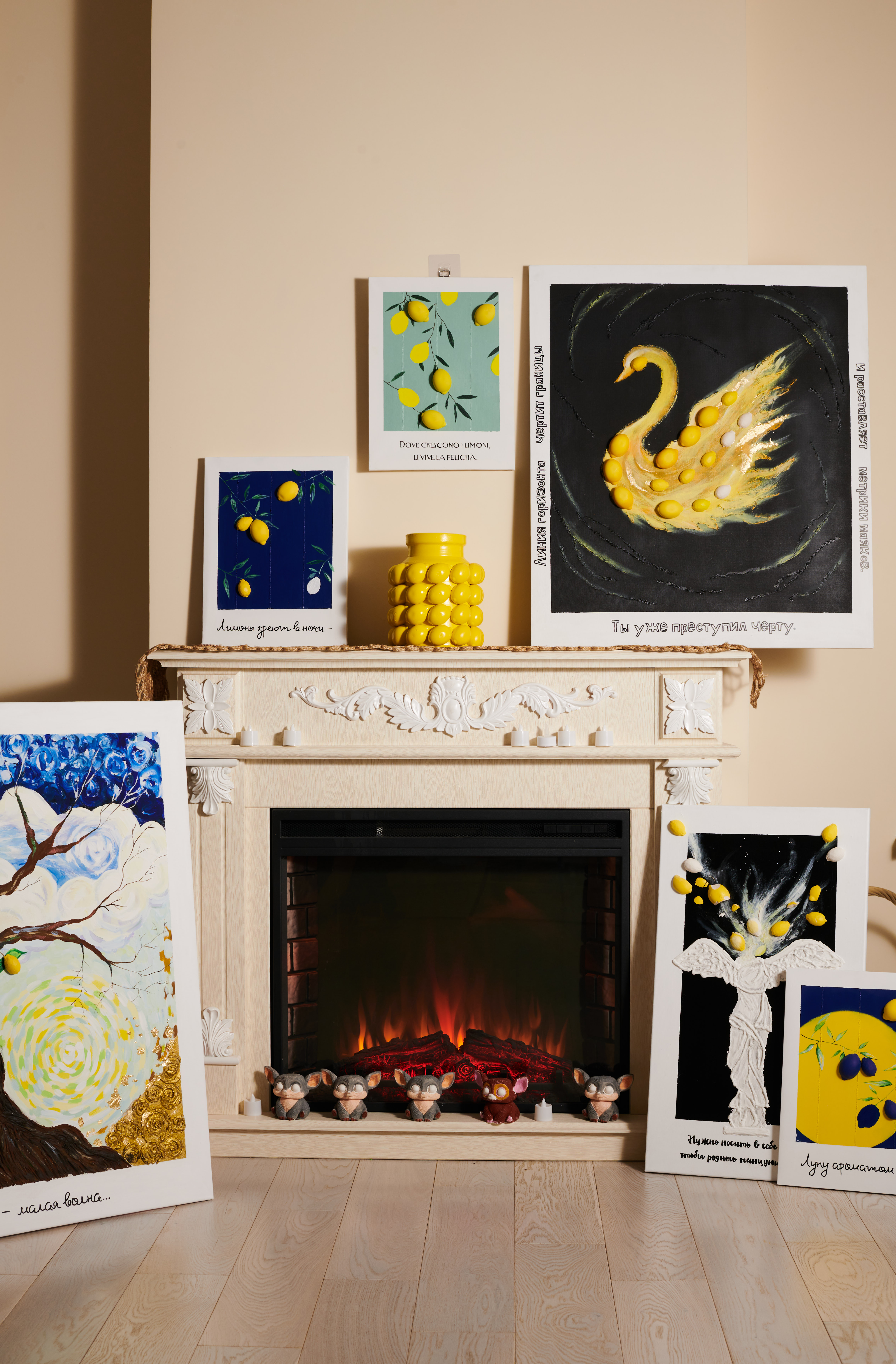
It shows not who a person “presents” themselves to be, but how they are structured internally at this moment. For example, in The Path of the Lemon, the lemon is not simply a fruit, but a metaphor for resilience, acidity as inner strength, and resistance to being averaged out. Every element of the composition — color, texture, interaction between objects, inscriptions — carries meaning and reflects specific aspects of personality.
Of course, it is not a “photograph of character” in an absolute sense. It is an instrument that captures the current state and, at the same time, opens a path toward transformation. Character is not static — and the artwork reflects that too.
4. What do you want to reflect in your art?
In my art, I want to reflect a person’s inner truth at a specific moment in their journey — the structure that is difficult to see in the mirror or hear in words.
I am not striving for beauty for beauty’s sake, and I do not create decorative paintings. Every art object in The Path of the Lemon is a precise visual profile. It reflects:
Where a person is internally right now — their current agency, inner supports, and limitations;
What forces and priorities drive them — what I call “acidity,” meaning resilience that does not dissolve into the environment;
What transformations are already maturing and ready to appear;
How they interact with the world — with chaos, opportunities, limitations, and their own nature.
I want the artwork to become a mirror that is more honest than habitual self-perception. I want the person to recognize in it not an idealized image, but a real map of their inner system. I want it to provoke not admiration, but recognition and a shift — when it suddenly becomes visible what exactly is blocking them, and what is already ready to become a resource.
Ultimately, I want to reflect possibility — the transition from “readiness for change” to a clear, visible image of that change. So that after encountering the artwork, a person does not leave with the question “Who am I?” but with the feeling: “Now I see where and how to move.”
This is not art for a gallery. It is an instrument of visual self-realization.
5. Have there been cases when your Art Profiling radically changed someone’s perception of themselves?
Yes, there have been such cases, and they are exactly why I continue doing this work.
One of the most vivid examples was the head of a large company who came to me during a period of deep burnout and with the feeling: “I have already done everything — but what comes next?” Based on the profiling results, we created his artwork, Under the Sign of Unpredictability, with a reference to Taleb’s Black Swan.
On the canvas, a golden swan appeared against a black background, with lemons in its plumage — a symbol that what he had considered his “chaos and failures” was actually his unique strength: the ability to turn unpredictability into an advantage.
When he saw the finished work, his face literally changed. He was silent for a long time, and then he said: “All my life I thought I was too risky and unsystematic. But in reality, I am someone who has long been living in a world where others are only just learning how to navigate.”
That artwork became an anchor point for him. A few months later, he completely reconsidered the company’s strategy, introduced new approaches to innovation, and, according to him, for the first time in many years felt not like a “burned-out veteran,” but like a person who was exactly in his element.
There were other stories as well: a female leader who saw in her artwork The Lemon of Knowledge. A New Eden confirmation of her right to step away from collective noise and create her own space — and this gave her the courage to launch her project. Or an entrepreneur who, through The Tree of Life, finally saw that time is not about deadlines, but about the quality of inner transformations, and radically changed his approach to management and life.
Art Profiling works precisely because the artwork does not tell a person who they “should” be.It shows who they already are on a deep level. And this recognition often becomes a catalyst for a powerful internal shift.
6. What does the process of creating an artwork look like?
The process of creating an Art Profiling artwork is always collaborative, deeply personal, and consists of several stages.
1. Deep profiling
We begin with a detailed conversation. I do not simply ask questions — I listen not only to the words, but also to how the person speaks, what metaphors they use, where pauses appear, and where the voice changes. I use my skills as an HR profiler and psycholinguist. We explore the current request, inner structure, key priorities, fears, support points, and what is already ready for transformation.
2. Finding the central metaphor
Based on the material gathered, I find the precise visual image that will become the heart of the artwork. In The Path of the Lemon, it is almost always connected to the lemon as a symbol of individuality, resilience, and authenticity, but each time it appears differently — through composition, color, texture, and additional symbols such as a swan, a tree, a map, a mask, and so on.
3. Creating and approving the sketch
I show the client a preliminary sketch or description of the composition. It is important that the person feels resonance. Sometimes important insights already appear at this stage.
4. Material embodiment
I work in mixed media: canvas, acrylic, plaster, relief elements, and sometimes interactive details, such as magnets in The Tree of Life. This is not a quick illustration — the artwork is created in layers, with attention to texture, light, and volume. Every element carries meaning: color, the position of lemons, inscriptions in Russian or Italian, and the interaction between objects.
5. Transfer and integration
When the artwork is ready, we meet again. I do not simply hand over the piece — we “read” it together. The person shares what they see and feel, and often the strongest shifts happen at this moment. The artwork remains with the client as a constant visual anchor and a tool for further inner work.
The whole process takes from several weeks to a month and a half, depending on complexity. It is always individual — there are no two identical artworks, just as there are no two identical people.
7. How do entrepreneurs use the results of Art Profiling in business?
Entrepreneurs use Art Profiling as a powerful strategic and managerial tool that translates inner states and systemic patterns into a clear visual format.
Here is how it works in practice.
Personal navigation for the leader. The artwork becomes a constant visual anchor. For example, Under the Sign of Unpredictability, an homage to Taleb, helps an entrepreneur stop being afraid of Black Swans and begin seeing them as an area of strength. A leader who once perceived his tendency toward risk as a weakness began, after working with the artwork, to consciously build the company’s strategy around the ability to operate in conditions of high uncertainty.
Corporate culture and team dynamics. Works such as Taste of the Lemon as a Right, a map of corporate culture, are used as tools for aligning values. Here, the lemon acts as a mediator between a person’s inner structures and the reality of business. Entrepreneurs place such works in offices or use them during strategic sessions so that the team can better understand what “our acidity” means — our authenticity, boundaries, and priorities.
Complex decision-making. The Tree of Life (I Govern the World) helps rethink the relationship with time: measuring it not by deadlines, but by the quality of inner transformations. Many entrepreneurs, after working with this artwork, reconsider KPIs, motivation systems, and their own personal leadership.
Transformation after crisis. As in the story I mentioned earlier: after deep profiling and the creation of a personal map, a leader was able to unite the team, come out of crisis, and take the company to a new level — including through digital transformation.
Ultimately, Art Profiling helps entrepreneurs make the invisible visible: inner structure, hidden resources, tension points, and zones of growth. The artwork works as a constant “mirror coach,” reminding you who you really are and where you truly need to move — both in business and in life.
8. What qualities unite the most successful entrepreneurs you have analyzed?
Among all the entrepreneurs and leaders I have worked with through Art Profiling and classical profiling, there are several key qualities that consistently repeat among those who reach a truly high level.
-
High “acidity” — in the sense of The Path of the Lemon. This means inner resistance to being averaged out and standardized. They do not try to “please everyone” and do not dissolve into collective norms. They have a clear inner position that they are willing to defend, even when it is not immediately convenient or profitable.
-
The ability to turn uncertainty into a resource. Almost all of them live in the logic of the Black Swan, as in the artwork Under the Sign of Unpredictability. What others perceive as chaos and risk is their natural habitat. They do not wait for stability — they build their strength on the ability to work with unpredictability.
-
A deep connection with their own inner structure. The successful entrepreneurs I have profiled have a developed capacity for self-reflection. They are not afraid to look at their shadows, limitations, and “dark” sides. That is why works such as The Tree of Life or Individuation resonate so strongly with them — they are ready to “break the egg” in order to reach a new level.
-
Orientation toward meaning and long-term transformation. They measure time not by the calendar and not by deadlines, but by the quality of internal and external change, as in The Tree of Life (I Govern the World). Money and results matter, but they understand that the real foundation lies in personal qualities, located in the “crown” of the tree, as in The Tree of Knowledge. 21st Century.
-
High agency and responsibility for choice. Even under strong constraints, they see points of control and opportunities for maneuver. They are captains of their own ships, able to align their vision with the team while not losing their own course.
Of course, each person is unique — and that is exactly what I show in my works. But these qualities create a common pattern: resilience without rigidity, courage without recklessness, and deep inner authorship of one’s own life.
9. Which archetypes do you most often see among entrepreneurs and leaders?
I see them through the prism of both my methodology The Path of the Lemon and Jungian psychology — Carl Gustav Jung and his followers, including James Hillman, Marie-Louise von Franz, and others. These are the main archetypes that appear consistently.
-
The Swan — Golden Swan / Black Swan → The Hero + The Trickster + The Self.
In Jungian terms, this is a strong manifestation of the Self — the center of the psyche that integrates opposites: chaos and order, darkness and light. At the same time, there is also the Trickster — the one who breaks old rules and brings something new through unpredictability. The Swan entrepreneur has already “crossed the line” and lives in a space where others are still afraid to enter. This is the archetype of transformation through crisis. -
The Lemon → Individuation + Shadow + Animus / Anima in a mature form.
The lemon is a vivid embodiment of the process of individuation. It is the rejection of the Persona — the social mask, the “sweet,” averaged image — and the acceptance of one’s Shadow: acidity, sharp edges, authenticity. The lemon symbolizes the Animus for women or the Anima for men in their authentic, non-adapted form — the part of the psyche that demands the right to be itself, even when it is inconvenient. -
The Tree of Life / The Tree of Knowledge → The Self + The Wise Old Man / The Great Mother.
This is a classical Jungian archetype of the Self as a holistic image of the psyche. The tree is the axis of the world, Axis Mundi, connecting the roots — the material, the unconscious, money — and the crown — spirit, meaning, personal qualities. In The Tree of Knowledge. 21st Century, the tension between the collective unconscious and the individual path is especially visible — a typical theme of Jungian maturity. -
The Captain of the Ship → The King / Ruler + The Wise Old Man.
This is the manifestation of the King, or the Ruler, in its positive aspect — the one who holds space, builds hierarchy, and at the same time remains part of the system. The Wise Old Man is also present here as a guide who is able to listen to the wind and the waves — the unconscious. -
The Hero of Individuation, breaking the egg → The Classical Hero + The Archetype of Rebirth.
This is the direct Jungian Hero passing through the stage of death and rebirth. Breaking the egg is the destruction of the old Persona and the emergence into a new quality. It is very close to the archetype of the Hero’s Journey, described by Joseph Campbell, who developed Jung’s ideas further.
These archetypes are not static — they live in the dynamics of individuation. The most successful entrepreneurs I have profiled are in the process of actively integrating these forces: they do not run away from the Shadow, but transform it into a source of energy.
10. How does art help people make bolder decisions?
Art in the format of Art Profiling helps people make bolder decisions because it makes the invisible visible and turns inner conflict into a clear point of support.
When a person looks at their artwork, deep recognition takes place. Suddenly, they see their real structure — where their true strength is, where the mask is, where fear lives, and where the new version of themselves is already ready to appear. This removes a huge amount of internal resistance.
Specifically:
It reduces fear of the unknown. For example, Under the Sign of Unpredictability shows that unpredictability is not a threat, but your natural environment. A person stops waiting for “stability,” which may never come, and begins to act in uncertainty.
It gives permission to be oneself. Works from The Path of the Lemon — especially The Lemon of Knowledge. A New Eden or Individuation: Without Breaking the World, One Cannot Build the Self — show that “acidity,” sharp edges, and the refusal to be averaged out are not flaws, but a right. When a person internally allows themselves to be inconvenient, they stop holding themselves back in their decisions.
It translates abstract values into a tangible image. In The Tree of Life (I Govern the World), a person sees that they themselves govern their time and transformations. This changes the criteria for decision-making: instead of “What is safer?” the question becomes “What corresponds to my path and my inner structure?”
It launches the process of individuation. As in the painting with the breaking mask and the lemon, art gives the experience that “breaking the egg” is not frightening. On the contrary, it is a necessary step toward a new version of oneself. After such an experience, many clients make decisions they had not dared to make for years: launch a new project, change the direction of a business, say no to toxic partners, or leave their comfort zone.
Art here does not work as inspiration, but as a precise instrument. It removes the gap between knowledge — as the result of experience — and action. A person does not simply “understand” that they need to be braver; they see themselves already existing in this new quality. And when the image exists internally, the decision becomes the natural next step.
11. With the development of AI and technology, does art still have a place?
Art does not simply still have a place — in the age of AI, it becomes even more necessary than before.
Technology and artificial intelligence are excellent at data analysis, process optimization, prediction, and scaling. But there are things that AI cannot yet replace and perhaps will never fully replace: Deep self-recognition on the level of the body and the unconscious.
The experience of resonance — when an image precisely touches your inner structure.
The ability to turn abstract insights into a tangible, living reality.
In my project The Path of the Lemon, I already integrate AI into the profiling process — analyzing large volumes of data, behavioral patterns, and linguistic structures. But the final art object is always created by a human for a human. AI helps make profiling more precise and scalable, but the artwork remains handmade. That is where its strength lies.
Art in the future will become a compensatory mechanism of the digital age. The more we are surrounded by algorithms, averaged content, and virtual reality, the stronger the need will be for an authentic, material, non-standard image. The lemon as a symbol of resistance to standardization is a very timely metaphor.
I see Art Profiling as a bridge between technology and the human soul. AI can process thousands of personality parameters, while art transforms those parameters into an experience that changes a person from within. That is why I am now developing a project where The Path methodology is combined with AI — to make deep profiling accessible to thousands of people while preserving its living artistic core.
Art does not compete with technology. It complements technology where the algorithm ends and the human being begins.
12. If you could create an Art Profile for a well-known modern entrepreneur, who would it be?
It would probably be Elon Musk — a truly strong and precise contemporary example of a person walking The Path of the Lemon. If I were creating his art profile, it would be one of the most powerful and multi-layered works in the project.
Why does he embody The Path of the Lemon so precisely?
Extreme “acidity” and resistance to standardization. Musk refuses to play by the familiar, dogmatized, and long-outdated rules of industries. He does not “sweeten” his goals to meet the expectations of the market, investors, or society. His approach often causes irritation, criticism, and even ridicule — the classic reaction to a “lemon.” It unsettles and heals at the same time.
Working with Black Swans as a norm. He lives in the logic of Under the Sign of Unpredictability. Constant uncertainty is not an exception for him, but a basic environment. He turns chaos into fuel for development.
High agency and authorship of reality. As in The Tree of Life (I Govern the World), he is literally trying to govern time and the future of humanity: multiplanetary life, neural interfaces, energy. He sees time not as a linear resource, but as a field for radical transformations.
Individuation through constant “breaking of the egg.” Musk has repeatedly broken his own masks and previous identities: from PayPal to Tesla, SpaceX, and xAI. Each time, he moves to a new level, even if to an outside observer it looks insane. He is also able to gather brilliant madmen around him — something that was not available to the geniuses of the past, such as Leonardo da Vinci or Lomonosov.
What would his artwork look like?
The central image would be a huge black swan carrying on its wings vortexes of white, radiant color, turning into stars of personalities ignited by Musk’s genius, intergalactic rockets, and neural networks. Or it could be a giant Tree of Life whose roots go into an intergalactic corridor and black holes at the centers of galaxies, while its crown turns into neural connections. The background would be black space with bright lemon-yellow accents, symbolizing his “acidity” that illuminates the darkness, revealing systems inside imaginary chaos.
The inscription could be: “You have already crossed the line. Now you must carry chaos within you to give birth to dancing stars” — a reference to Nietzsche, whom he admires.
Musk is a modern Chaos that does not simply exist in an anti-dogmatic form, but uses that form as both a weapon and a light for changing civilization. He vividly demonstrates the main idea of the project: true strength is born not from the desire to please everyone, but from deep loyalty to one’s inner nature.
13. What is the main insight you would like every viewer to take away after encountering your art?
I want every person who looks at the works from The Path of the Lemon to take away one main insight:
“To be yourself is not a privilege, but a right. And this right must be consciously claimed.”
You do not have to be sweet, convenient, and understandable to everyone. You do not have to dissolve into the “average person,” who in fact does not exist. Your “acidity” — your unique nature, your sharp edges, your true priorities and boundaries — is not a flaw that needs to be corrected. It is what makes you alive and capable of creating your own path.
I want a person to leave the encounter with the artwork with a deep sense of permission:
Permission to see their real self, without familiar masks.
Permission not to be afraid of their difference.
Permission to turn inner chaos and contradictions into a source of strength.
Permission to govern their own life and time, rather than submit to external rules.
The main insight is recognition: “This is who I am. And I have the right to be exactly this way.” And after that comes action. Because when a person truly sees their inner structure, the decision to move forward becomes natural and much bolder.